Setting up a tank is not difficult, but it is where a lot of beginner aquarists go wrong.
A fish tank is more than just a cage, it is a garden. You wouldn’t keep a rabbit in a cage with just air and rock, and you don’t keep a fish in a tank with water and rock. There must be life in every inch of it, all the way down to the substrate.
Aquarium gravel is useless, you don’t need it, and it’s more likely to just get in the way. Some aquists use it for scattering over boulders, but it will eventually sink anyhow, so I don’t bother. What you actually need is mud, any clean dirt is fine, and when I say clean I mean free of chemicals, such as herbicide or insecticide. Animal poo is fine, even good. You need about an inch spread evenly in the bottom of a clean empty tank. (Clean always means free of soaps and chemicals), placed somewhere away from too much natural light. The higher the level of sunlight the higher likelyhood there will be for algae.
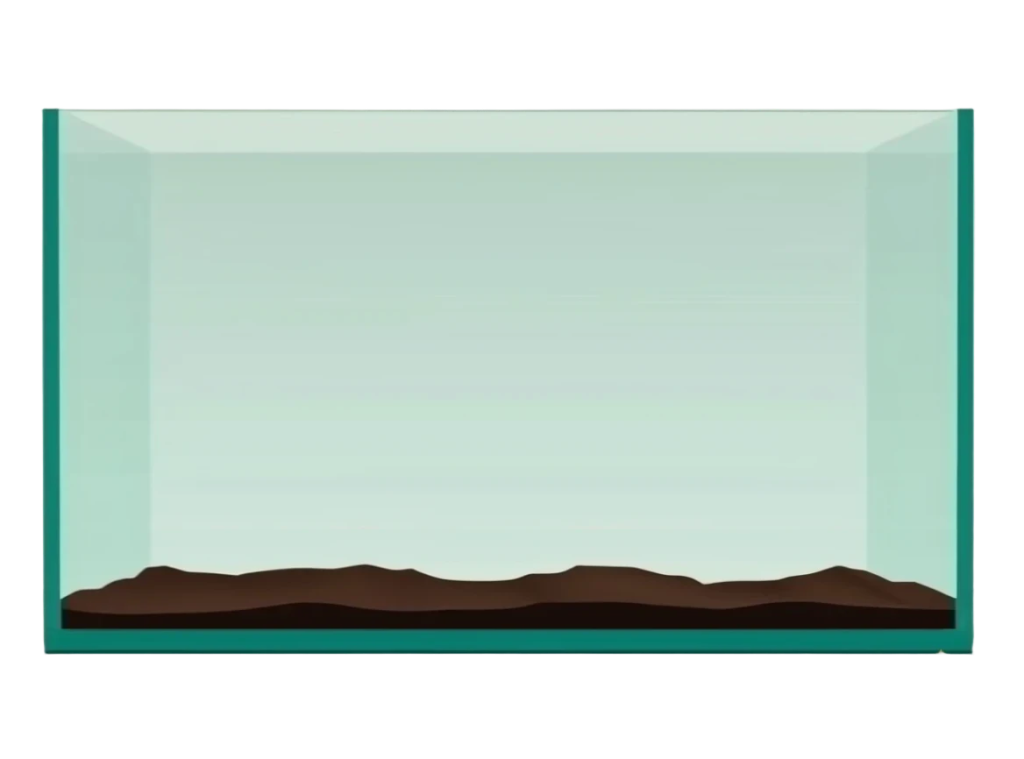
If you want to do some more fancy shaping, like higher at one end that’s all good fun, but don’t spend too much time on the detail, as it will sink over time.
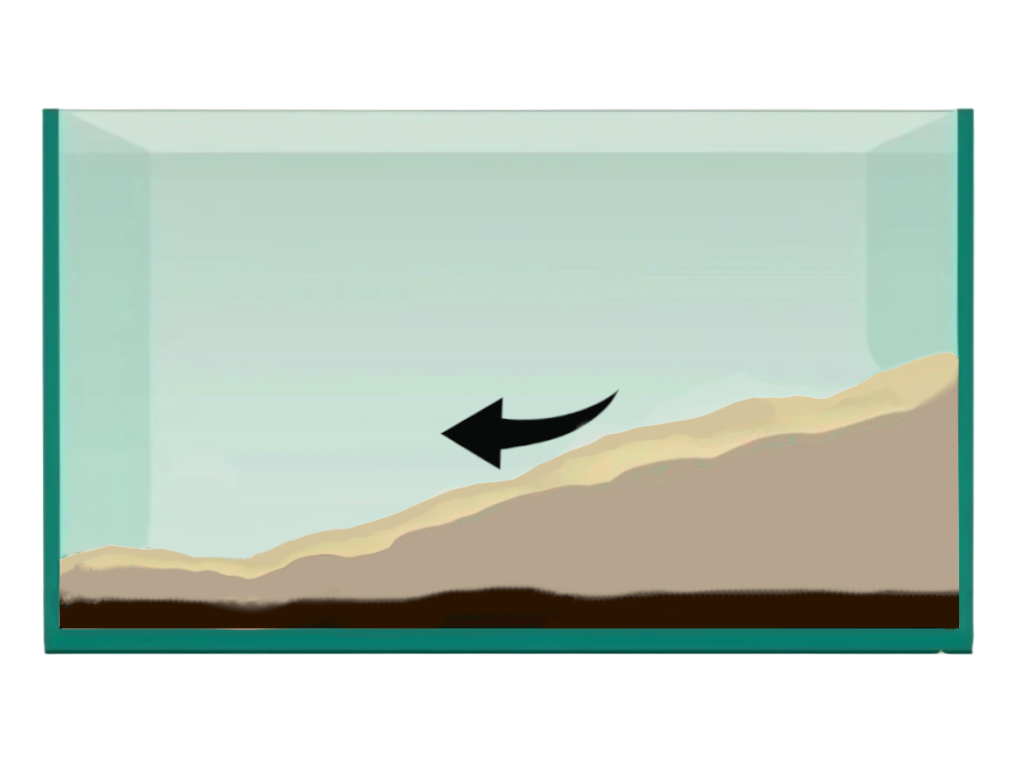
A serious incline will only work in a larger tank, because if you try to make hills too steep they will slip when you put the water in and flatten themselves out. If you are only making a light incline you don’t need to include it into the dirt shaping. We only need a thin layer.
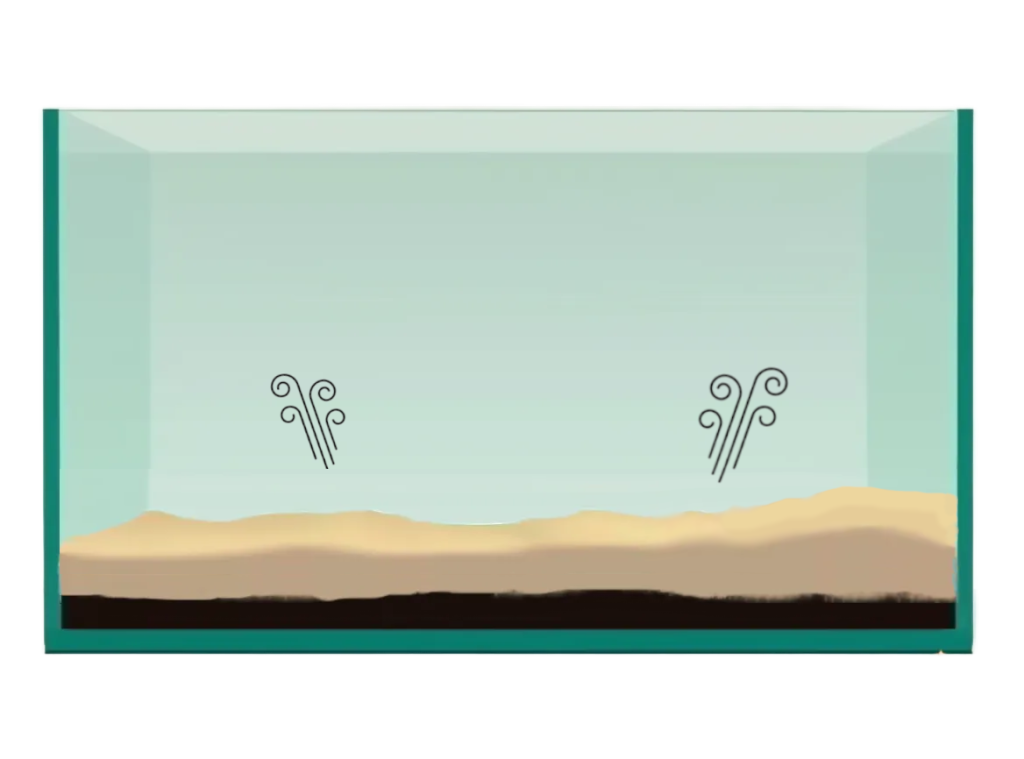
Adding sand is when you would do any shaping you desire, but remember to make it at least two inches deep in the shallowest spot, otherwise there’s a risk of the mud getting through and murking up the water. Be sure to use fully dry sand for hill shaping, as it behaves the same as wet sand. If your sand is damp, it will clump and be able to be much steeper, then collapse when the water comes in. If your sand is damp and you don’t want to wait just allow for it to sink, flow and settle. If you’re making a flat substrate then it should be between two and three inches thick all over, to insure that the mud can’t escape.
After that we come to the proper scaping. Depending on what theme you’re after then you’d use rocks or wood. I like rocks because they’re easier to settle, but that’s just because I’m lazy. Pieces of wood look good mixed in, and if you’re growing epiphytic plants then they’re always good. If you have a slope you’re trying to keep up then a heap of rocks at the bottom is a good idea, though it will still settle and become a plateau.
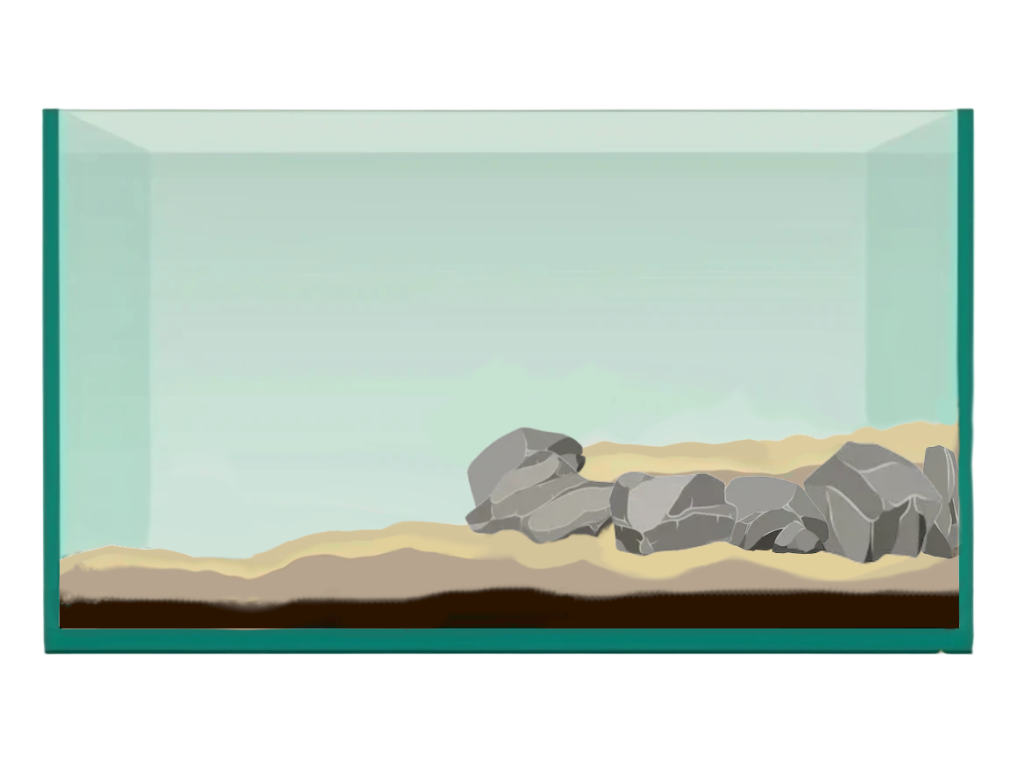
Plateaus can be very fun depending on how you use them. You could have wood stacked on top with epiphytes, leave it as a clearing, or plant a carpeting plant. I piled rocks on top of a plateau in one tank, and as nice as that can look you want to make sure it doesn’t weigh so much that it pushes the plateau down and completely destroys it.
Putting very large ornaments like a branch taking up the length of the tank is a popular style, though if the wood is sourced from nature rather than a shop then the cleaning job is a bit of a nightmare. We don’t want dirt or woodchips in the water if we can avoid it, as the place will go murky.
Planting a tank is always very fun, but it’s important to make sure you are sourcing your plants from somewhere you can trust. Half the plants you buy in a a pet shop are actually not true aquatic plants which will rot away and foul your tank in no time. Believe me I learned this the hard way before I found out more online.
There are other plants which are aquatic, but have temperature requirements, making them impossible to keep in some places. In far south Tasmania where I started my journey into aquascaping the water got down to 15 degrees in winter, making it impractical for plants like bacopa and ludwigia. Here is a list of great plants for water temperatures ranging between 14 and 20 degrees.
Green milfoil, (Myriophyllum spicatum) Dark green lacy leafed plant, great for backgrounds or jungles.
Pearl weed, (Hemianthus micranthemoides) Light green, soft round leaves. aggressive weed, all positions. high light
Vallisneria, (Vallisneria spiralis) A very long waving grass with wide blades, good to grow in the background.
Lilaeopsis, (Lilaeopsis brasiliensis) a short foreground grass which spreads in long lines by runner.
Hair grass, (Eleocharis parvula) a very fine dark green grass, grows vigorously when trimmed. Mid to foreground.
Elodea, (Elodea canadensis) Dark green fleshy stems and pointed leaves. Background plant, needs pruning
Christmass moss, (Vesicularia montagnei) Lacy dark green, conical fronds. Mid to foreground plant, likes a prune.
I have used all of these plants to great effect, and though there are many more, this is a good place to start. Epiphytic plants such as java fern can be grown in 15 degrees, but there could be trouble if the water gets any cooler. One plant which will grown in any water at all is hair algae. Once it comes it’s annoying to get rid of, so watch out for the bugger.
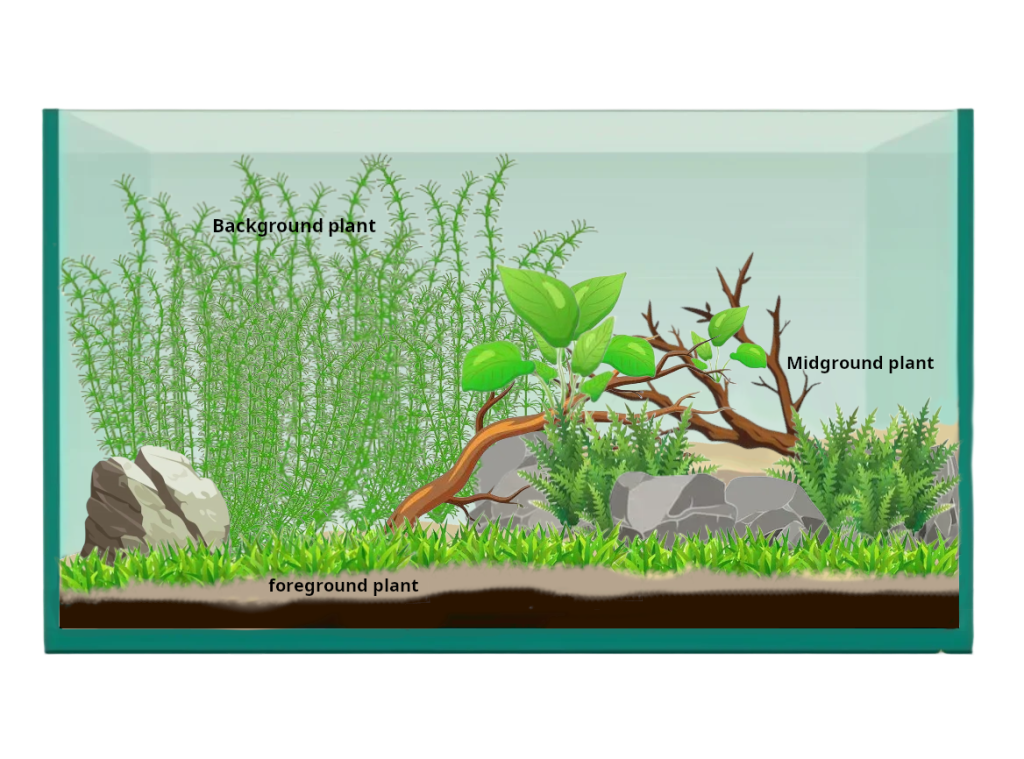
A tank can support life even if it looks like a mess, but in order to make it look really pretty we want to pay attention to design. Start with a background plant. In a larger tank I would use milfoil or elodea, though elodea can be a nightmare if you’re busy and don’t have time to hack it. Vallisneria, ‘vall’ can look nice growing from a corner, as it will stream out over the rest of the tank. Valls also have to be trimmed, as they will eventually get so long that they fill the tank with metre long blades of thick green grass all coiled up. My sister and I set up a tank which was entirely epiphytes, growing on both wood and rocks, which we heaped in piles on top of a flat and very shallow substrate of pure sand. The soil in the bottom of a tank is giving nutrient to any plant roots pushing through, however epiphytes don’t grow on the bottom, they suck all they need out of the water. Maybe for this reason there has never been a spot of algae in that tank. Algae is considered a big problem in fishkeeping, and though it can be annoying, it’s much less of a problem than parasites. But neither of them should bother you if you’ve built a happy, healthy and balanced ecosystem.
It is necessary to have a large amount of whatever background plant you’ve chosen. If you don’t know what you like then have a browse on Sydney-aquascapes.com.au. They sell a wide range of true aquatic plants for background, midground and foreground. They are not sold in those particular categories, but there are some you just wouldn’t have at the front (such as elodea or milfoil). Background plants aren’t going to be the centre of attention, so it is best to plant them as simply a wall to partly hide the back glass. Moss is best used as a midground plant, wedged between rock where it can reach out and swamp its captives. I have grown it on wood, but it has to be tied on first. Likewise the crested java fern and other epiphytes have to be tied on so they can take root. I have tried to wedge them, but they just managed to keep on escaping from their correct places. Some people will use super glue to attach the plant by the roots, but I just know that the glue is going to be leaching nasty chemicals into the water. Cotton sewing thread is what I have used. It’s strong and fine, and breaks down over time as the roots take over. Pearl weed can look lovely as a midground plant, clipped into a natural shape, or a rounded ball depending on personal preference.
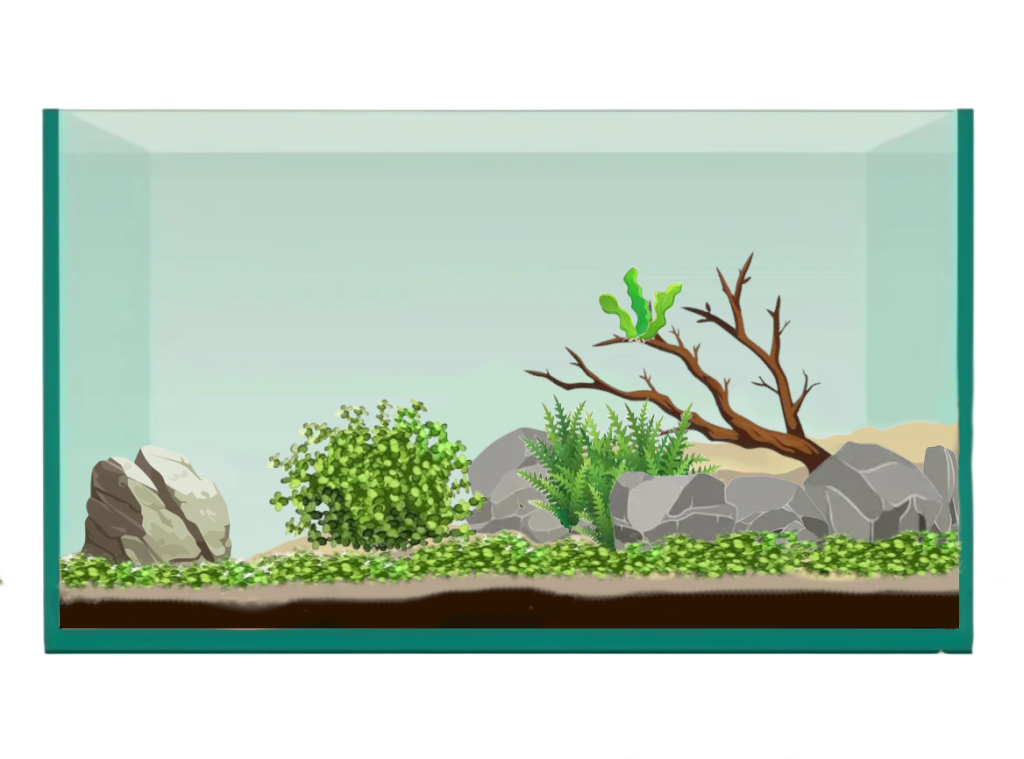
Pearl weed is also a good foreground plant, and great for smaller tanks when turned into a carpet. Pear weed will only be whatever you make of it. If you lay the stems down across the sand and weigh them down they’ll start to shoot up leaves all along the stems. To keep it short you’ll have to be dedicated to trimming it at least every two weeks, and it will slowly thicken. For a larger tanks lillaeopsis makes a great foreground plant, as it only gets to around 5cms high, and the only maintainence needed is pushing down the runners to stop their white roots from showing.
Some people use aquarium tongs for planting, but I don’t have such things, and find my fingers work fine. It’s best to put a few inches of water into the tank before you start planting, or the sand will shift about and the things you’ve planted will become uprooted. Most of the plants I don’t weight down, I just gently push about an inch of the stem into the sand, and it tends to stay in. For many stemmed plants like milfoil I poke in bunches of four or five into the same hole, which helps for background density. Milfoil has to be planted in bunches, otherwise it takes eons to fill out, because there are so many tiny stems. Smaller rocks and large pebbles are good to place at the foot of big rocks, to give a natural look, but make sure no two are the exact same size, as that will make it look artificial. Even pieces of gravel can work as long as they are the right colour to work with your larger stone. Wood should also all look similar, as you don’t want it to look inconsistent. Smaller twigs give a natural look, as well as snapped ones still attacked to a branch. I understand some people like a more neat look, and if you’re one of those then that is fine, make it look pristine, but remember that if you try to keep it sterile it will die.
The background, midground, foreground is a good principal to start on, though depending on personal style you might prefer a full tank with a clearing. I had a very large guppy tank which was a jungle with an attractive clearing. One thing to note with this style is that there won’t be a midground. You will have a jungle, and then some kind of ground cover in the clearing. Another thing is that this style requires more regular pruning. If the tall plants start to close in on the clearing the fish will feel claustrophobic, which will lead to depression, and possibly eventual death.
Tap water cannot be used in a fish tank without water ager, and even then I don’t believe it gets everything out. Chlorine is poisonous to fish, and for a healthy environment we want only rain water. If you don’t have access to a lot of nice rain water then some ultra clean drinking water from a supermarket will work. This might be a more expensive option, rather than just going to a clean stream somewhere. Beware of water from creeks however, as it can carry unwanted bacteria and water parasites, especially from a place where there is already aquatic life. eg, green algae or moss on the rocks. Water can be sorced from streams only if the rocks are bare and the water is fully clear. Mountain streams would generally be fine. If you just pour the water in then it will tunnel a hole right the way through to the mud, thus fouling everything. It has to be poured in slowly, and is best done onto rocks. If your tank is more wood based then a saucer can be placed on any free sand, or held by a helper. It will likely be a little murky from grit and debris off the plants and sand, but that will settle in time and not be a problem. Fill the tank up almost completely, leaving less than an inch of glass above the waterline. If your tank is smaller and somewhere it’s likely to sway then leave a little more space.
Any general aquarium light is fine, so long as all the tank looks sufficiently light. Some plants like pearl weed need higher light, and will begin to stretch without it. Once a light is set up you can sit back and look at your handywork. A little murky, but well on the way to being very beautiful.
It’s best to leave it a few days before we charge ahead and introduce life, but when the time comes make sure you do it slowly. To start with we’ll just add some snails. Ramhorns are prettier, but tend to be not as strong as the good old pond snails. They sell them for a few dollars each on Sydney aquascapes, so only buy a few. If you buy four that will be plenty, as they breed like snails. Now, though snails are not fish, they are still living creatures, and need to eat. In a frehsly established tank there is very little to eat, so the time to start feeding has come. On the back of pretty much all the fish food packets it says to feed two to three times daily or more, but that is a serious overstatement. For a natural aquarium, you will feed at most once a day. Hikari micro pellets are the best, and you only want a tiny pinch, like the amount of a salt a stingy person would use. But don’t sprinkle it on the top, as the snails won’t get it. Hold your fingers under the water and rub them together gently, letting the food sink dramatically to the bottom. Snails are slow, but they will find and eat it eventually. Leave it a week, then we get on to introducing shrimp. There are an infinite number of shrimp colours, though only the basics are available. Cherry, ghost or crystal, whatever is to your taste, it doesn’t matter. You can request male and female, though most people seem to struggle to tell them apart. I can teach you how here.
One male and one female should be fine, and if they’re happy they will breed. A shrimps breeding cycle takes longer than a snail, and the female will carry around the eggs until they hatch. Unless you have sharp eyes you won’t see the babies until they get bigger, and they’re super tiny. Don’t be worried if your shrimp don’t breed for several months, and don’t be suprised if they do it in one. No one can predict what goes on inside a crustacean’s head. You’ll want to leave it at that for a while, so things can settle, feeding a tiny pinch of Hikari under the water every three days. If the water becomes murkier, then cut it back to every five days. Make sure it’s less than you think, as it’s very high protein.
After two weeks you could start thinking about fish. Only small ones to begin with, and that also doesn’t mean any old small fish. It is a common misconception that tropical fish need heaters for their water, when that really isn’t true. A reasonable portion of the tropical range can live in 15 degree water, which will be the lowest temperature in a house. Here is a list of good beginner fish, some are considered tropical, others are cold water.
Guppies; A very popular and hardy species of small fish. They breed easily and are friendly and engaging.
Black neon tetras; A better alternative to the normal neon tetras, which are more delicate to water changes.
Widow tetras; A disk shaped fish, coming in pure white and grey striped. They are extremely quick, very fun to feed.
Barbs; Barbs are attractive, colourful fish. They are speedy fin nippers, so can’t be kept with guppies.
Khuli loaches; techincally a fish, but looking more like an eel, khulies are attractive bottom feeders.
Corydoras; bear in mind that they will sift through all the sand, so wait until all plants are rooted first.
These are all good fish, though some are not suitable for smaller tanks, as they will outgrow them and want more room. Most of the fish you buy in a pet shop are actually young, so make sure you check out my fish page before you go buying. There are some fish of course which you should avoid for various reasons. Many can be purchased once you have a little more experience, but start with what is easy or you might just have to learn the hard way, which is not fun. Here are some fish that should not but put into a beginner tank.
Pleco; While a very attractive fish in many colours, plecos cost a lot and tend to die on you if things aren’t perfect,
Platy/Molly; They are fun and strong fish, but will eat most easy growing plants such as pearl weed and milfoil
Goldfish; An old classic, however they will eat almost everything, and uproot half the things you plant.
Sucking catfish; These fish suck. They eat the slime coats off other fish, causing injury, and leading to fungus.
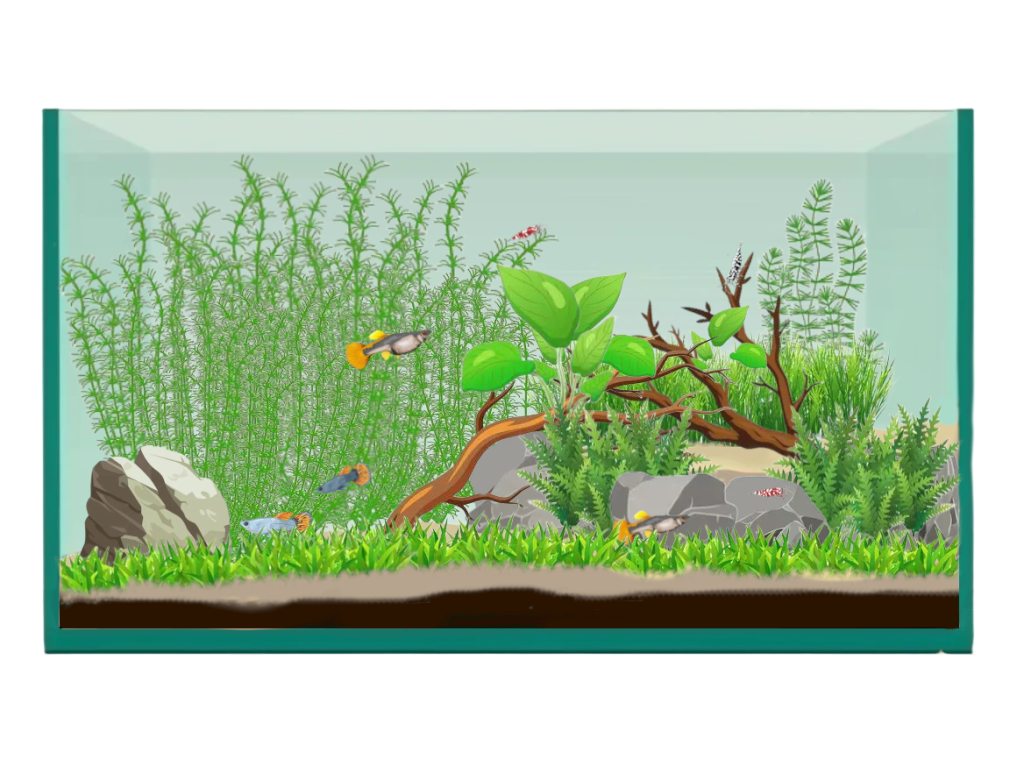
For a guide to which fish are best for which tanks and temperatures, read my fish page. Some people will quarantine their fish for a few weeks before putting them into a tank, but I just can’t be bothered. Make sure the fish are healthy before you buy them, having no white spots on their bodies, or acting lethargic. You should be buying some kind of tetra or guppy depending on what you like, but it should be small and strong. Get only a few to start with, maybe four. Rest the bag in the top of the tank until the water temperature is the same, then unroll the top and add in some water, just a little in a cup. Pour it into the bag slowly until the fish calm down. lift your fish out and place them into the tank. Some will swim away in a hurry, others will want to sit in your hand and huff. Let them have their way, and don’t worry when they hide in the greenery with their chins in the sand. They are in shock from water change, and from seeing a place so lush. Fish are bred in bare glass tanks, and have never seen a planted tank before. After a few hours they should be swimming about, but they might just sit around for longer.
This is the beginning of your aquarium, and you will want to feed the same small amount every day now. If the water begins to cloud then decrease to every second day. If the clouding continues change %20 of the water using clear rainwater to replace. Repeat every two-three days and keep feeding minimal. More plants can always be added in other places if you think you’d like to change something. In a lagre tank your first fish are more of a primer than anything else, and if you want something more fancy you can move them out and replace with new fish. There has to be fish or shrimp in the tank at all times to keep the poo eating bacteria alive. If you remove the animals from a tank for a prolonged amount of time and then put some larger ones in there might be a period of cloudiness. Having shrimp in at all times is a very good practice, and you don’t see them that much if they’re a clear or green variety. But don’t forget to feed them! Once your tank has had a smaller fish in it for a while, probably about a month, then you can go to something bigger. For a large tank like a 200 litre there is a vast range of fish you could get. Good luck!

Dr Freya is not only beautiful, but also very clever
Really? And do you know if you need to be logged in to leave comment?
No, I’m not logged in now. I think it works, you just need to put in a little more private information first
What a fabulously lovely website my fine friend, I do hope for your sake that your business works well and you get many customers and successes. And if you don’t then that’s ok too at least you tried.
I didn’t read it!!